Service
Re-Design

Introducing changes in the current mechanisms and their depiction.


Rethinking Translink Safety

A 4-Tier Approach

  • People don’t know what level of help is available (urgent vs. discreet).

  • Transit police lack trust, leading to low reporting rates.

  • The yellow emergency button is hard to notice and underused.

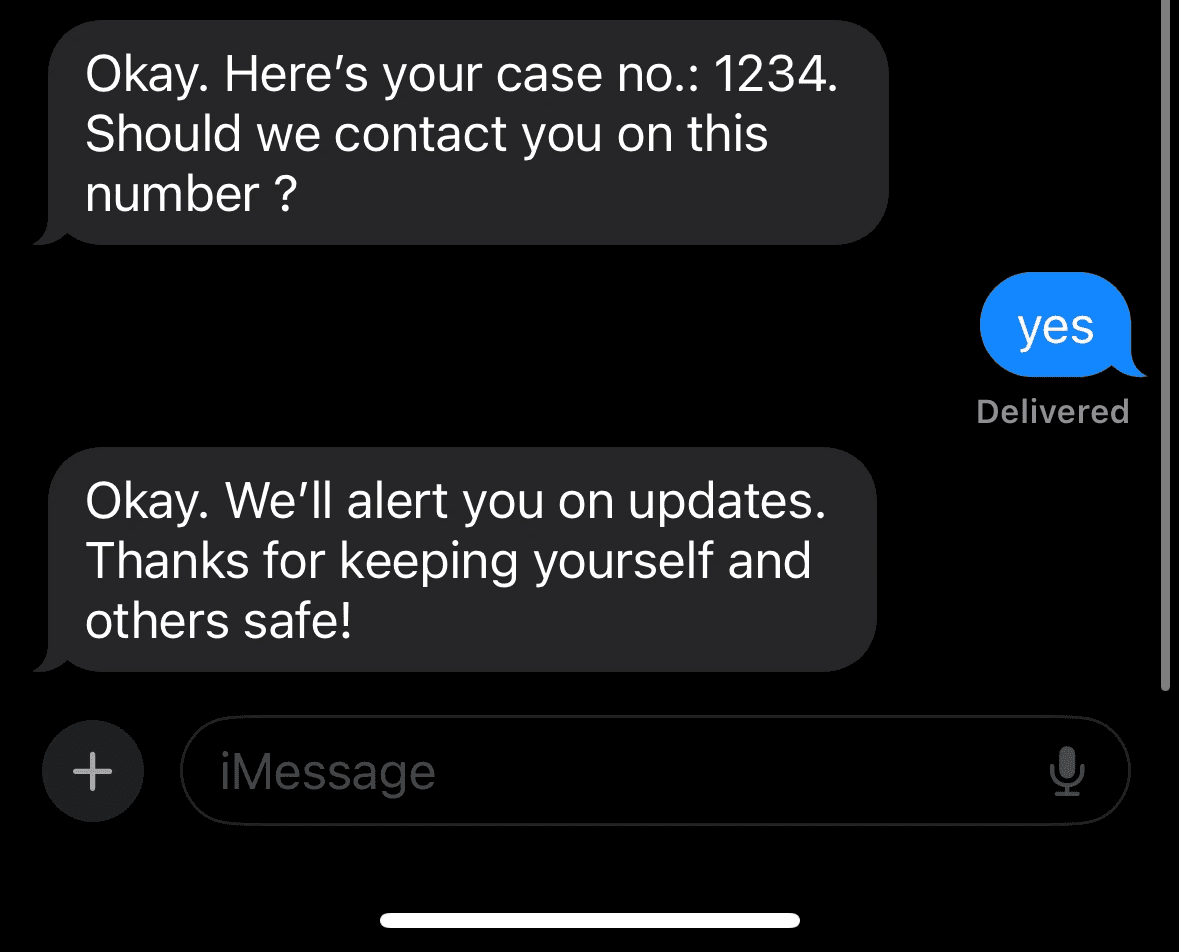
  • The 877777 texting service isn’t optimized for immediate support.

Problem Space

Objective

My Roles

Understanding the problem space

Result

Analyzing the current system

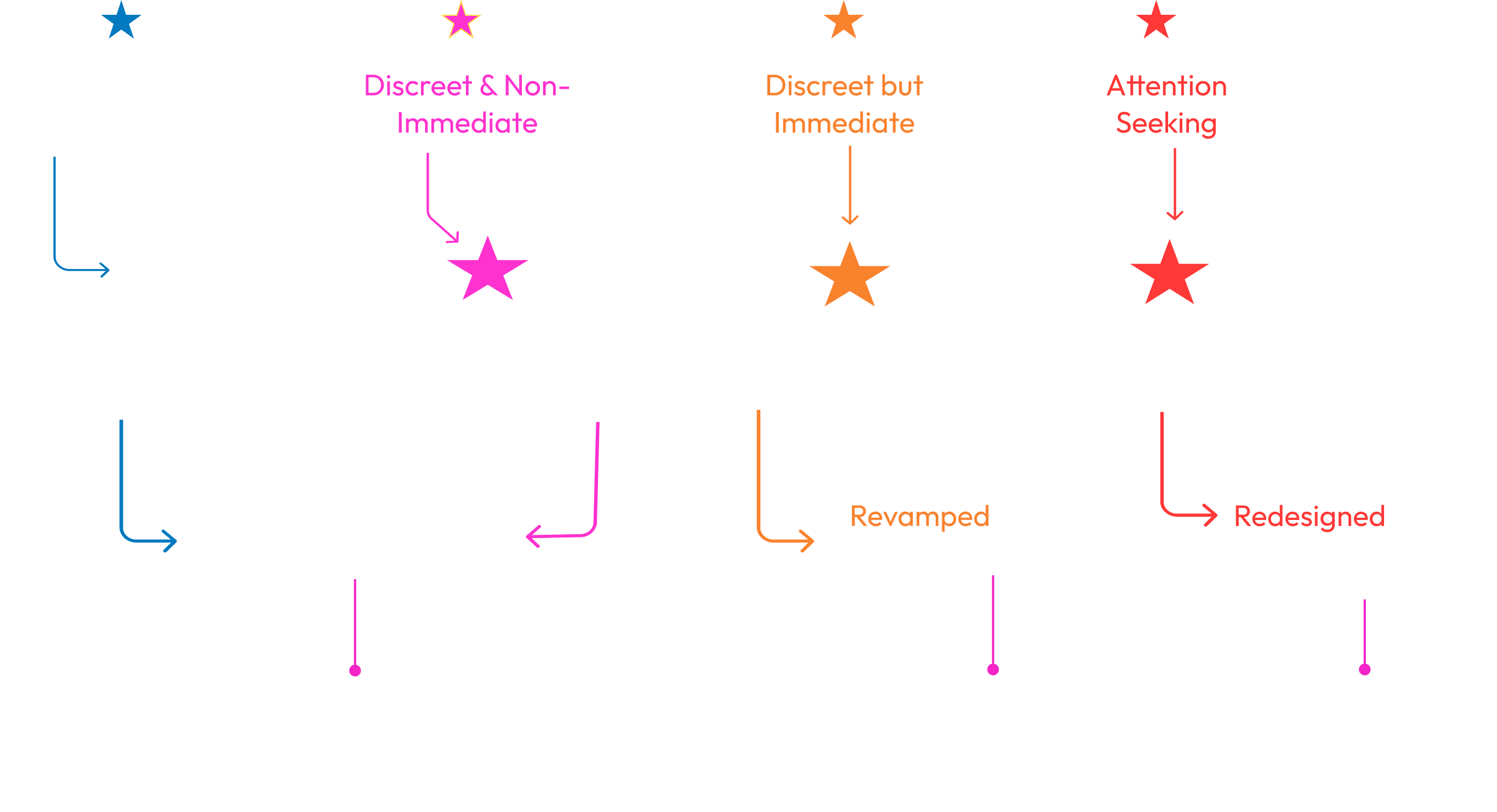
Final Approach : 4-Tier System

Key User Groups

Card Sorting

New texting system with
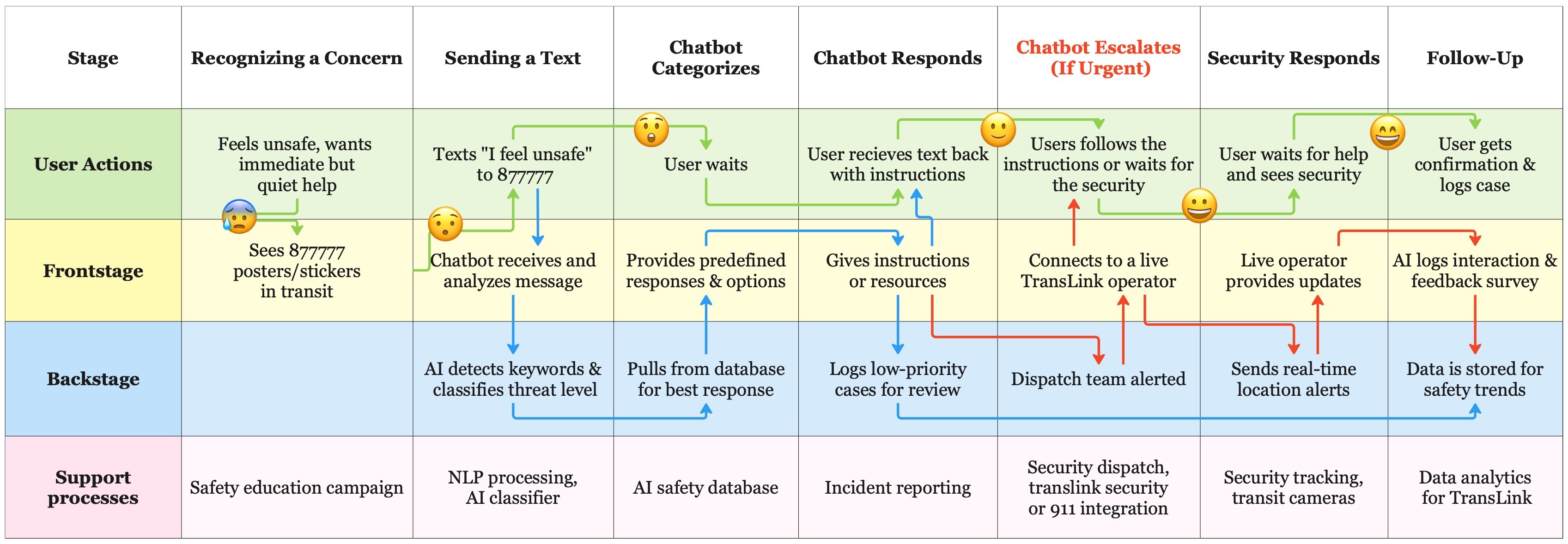
AI Chatbot : Service Blueprint

New texting system with AI Chatbot : Service Blueprint

Outreach Plan

Results

Transit safety is unclear and untrustworthy.

Power dynamics play a huge role in determining the kind of help people need, and for many marginalized groups, navigating safety on public transit is complicated by a lack of trust in authorities due to systemic prejudice.


Because of this, I wanted my project to specifically address safety situations that these groups experience.

UX
Design

Making sure users can navigate the new system smoothly.


Visual
Design

Designing posters for awareness and also the trust campaign.

This project started as an accessibility-focused redesign of transit safety, but after an excluded groups and universal barriers workshop in class, my focus shifted to the unique safety challenges marginalized groups face.


  • Re-Design emergency assistance with a tiered response model.

  • Improving the 877777 texting service for discreet and immediate help.
My research focused on understanding how people currently seek help on transit and the barriers they face when accessing safety services.

My research focused on understanding how people currently seek help on transit and the barriers they face when accessing safety services.

I conducted secondary research by analyzing online discussions (e.g., Reddit, transit forums) to find out public opinion about existing safety features

A lack of awareness about the texting system.

Hestitation in reporting incidents due to mistrust in the authorities.

A need for a clearer differentiation between different levels of emergencies.
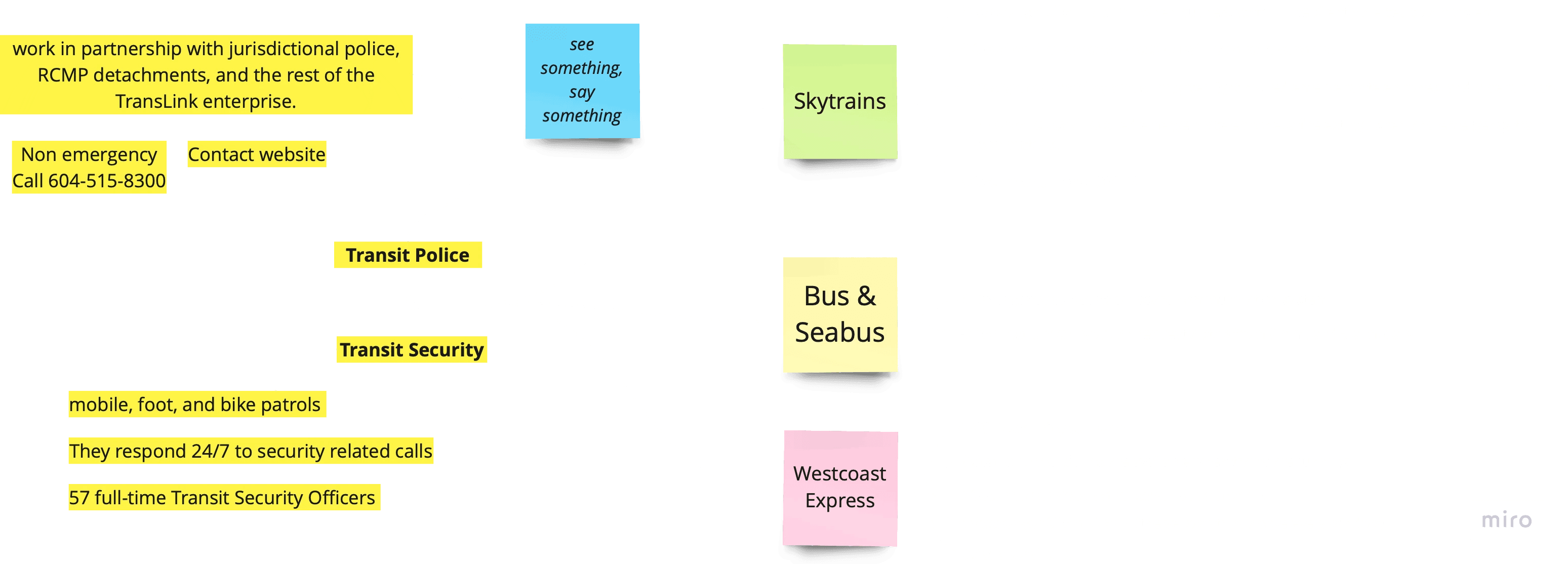
I did secondary on translink’s safety website and I mapped out the connections between the different components of current the safety system.

The current categorization does not cover all the possible safety situations one could be in, especially queer folks & women, because of how societal power dynamics work out.

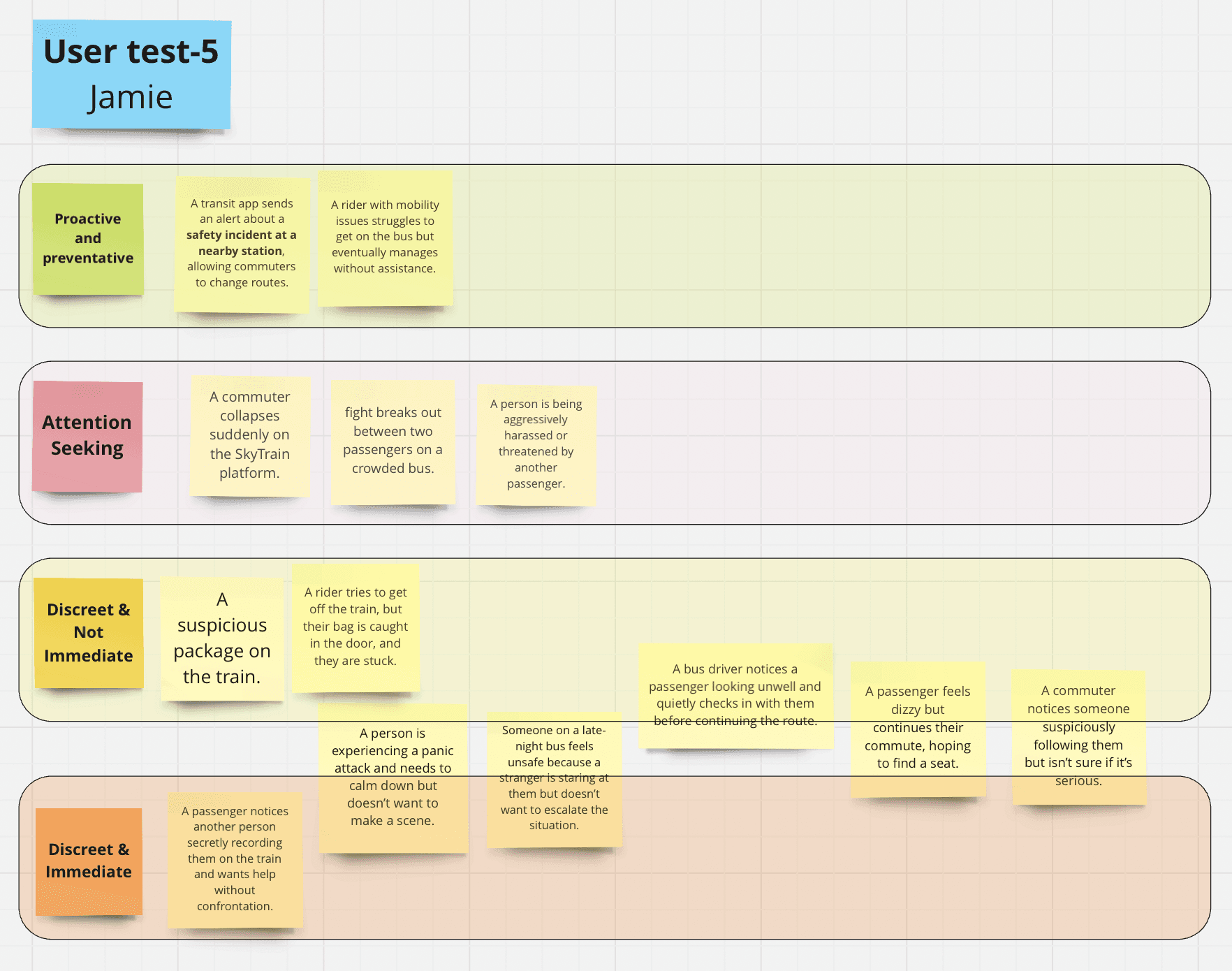
Participants were given 10 different transit safety scenarios and asked to sort them into the tier they believed was most appropriate.

This aim was to assess:


- Do people naturally categorize safety situations the way I envisioned?


- Do they find the four-tier system intuitive and useful?


- Are there any overlaps or gaps in how incidents should be handled?
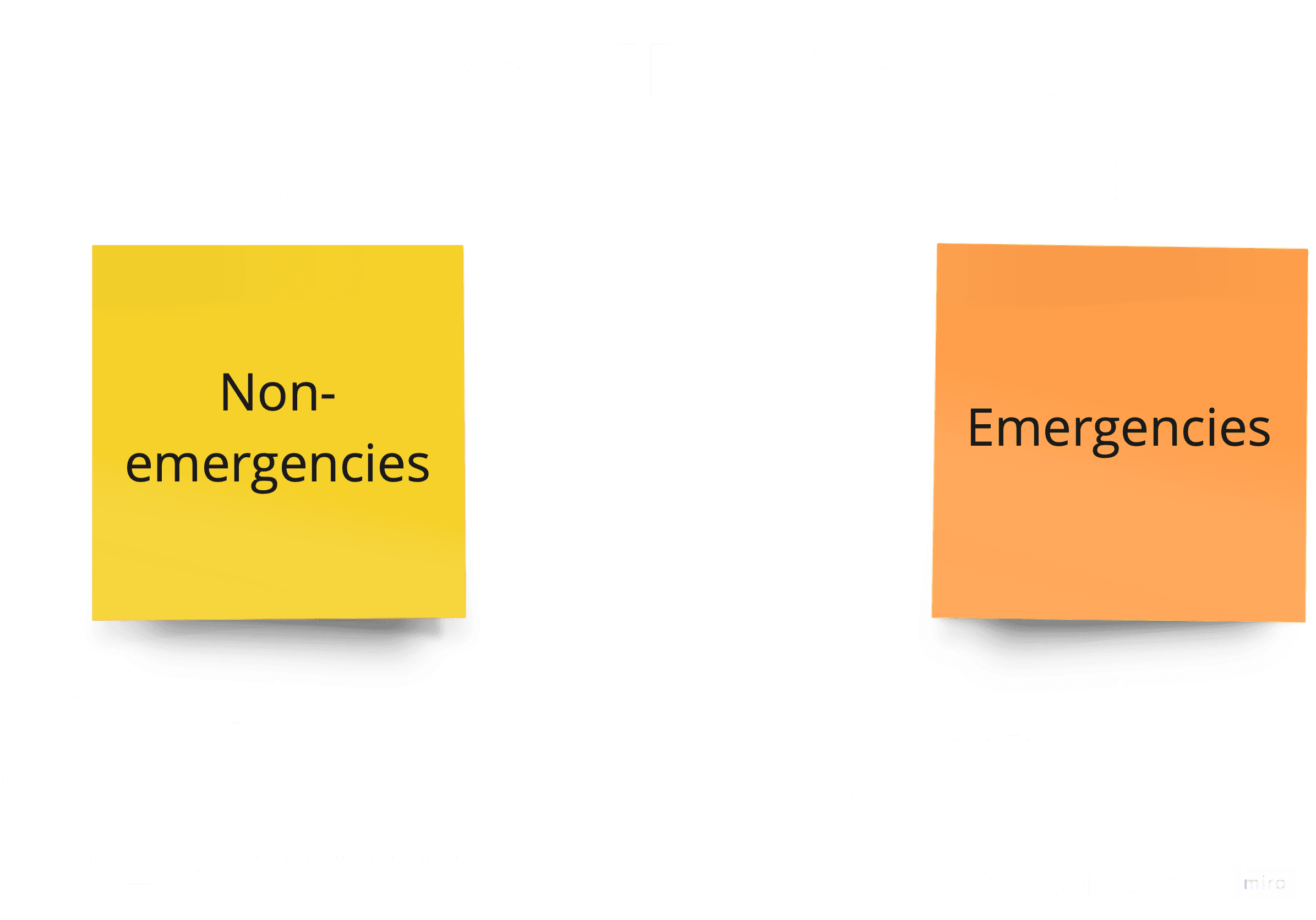

I conducted a card sorting exercise where participants categorized different transit safety scenarios into one of the four tiers.

  • Most users were able to correctly categorize incidents.


  • Some users struggled to distinguish between Discreet & Immediate and Attention-Seeking.


  • Many didn’t know about the texting service (877777) and weren’t sure when to use it versus calling 911.


  • Mistrust of transit security remained a major barrier to reporting incidents.
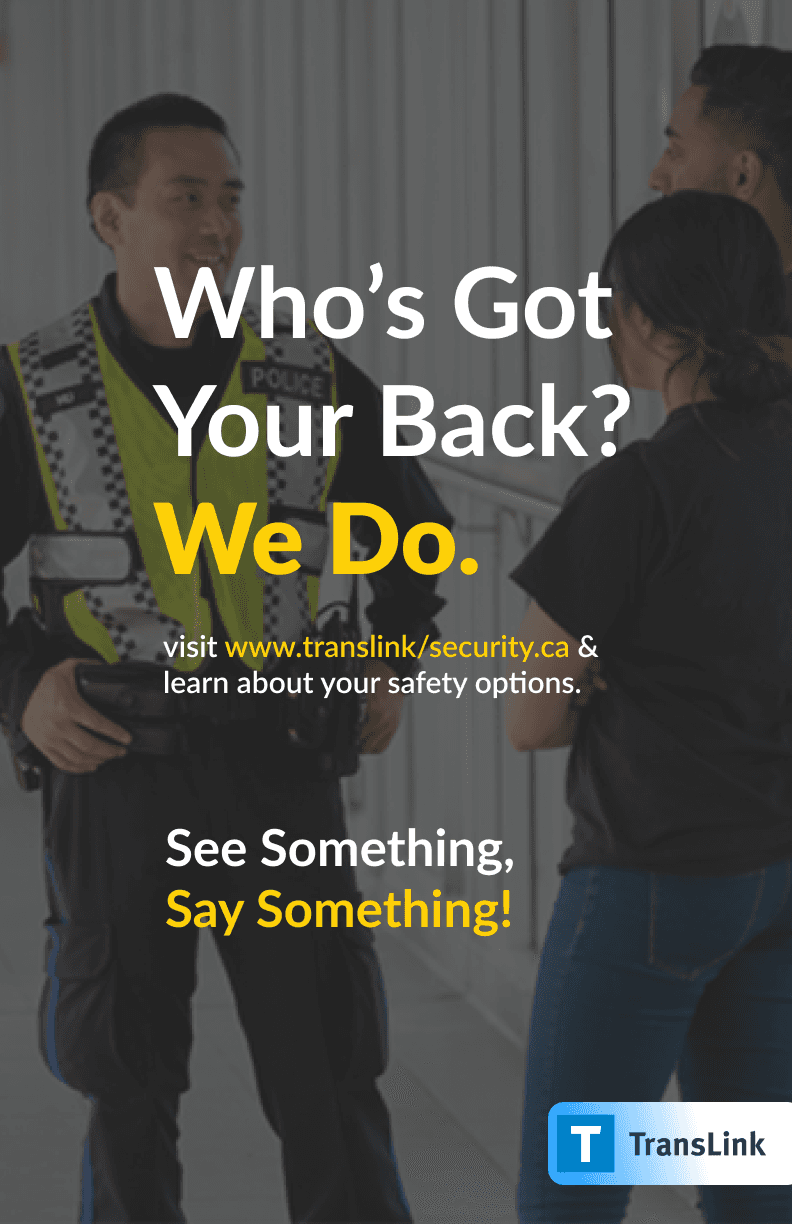
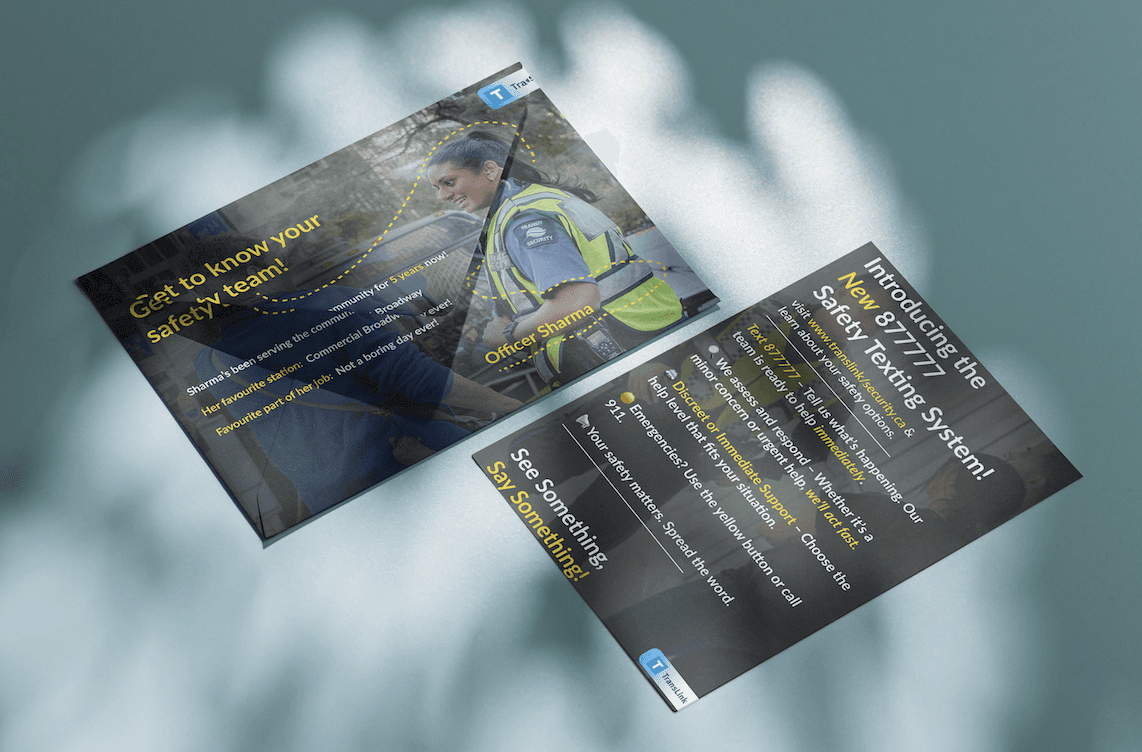
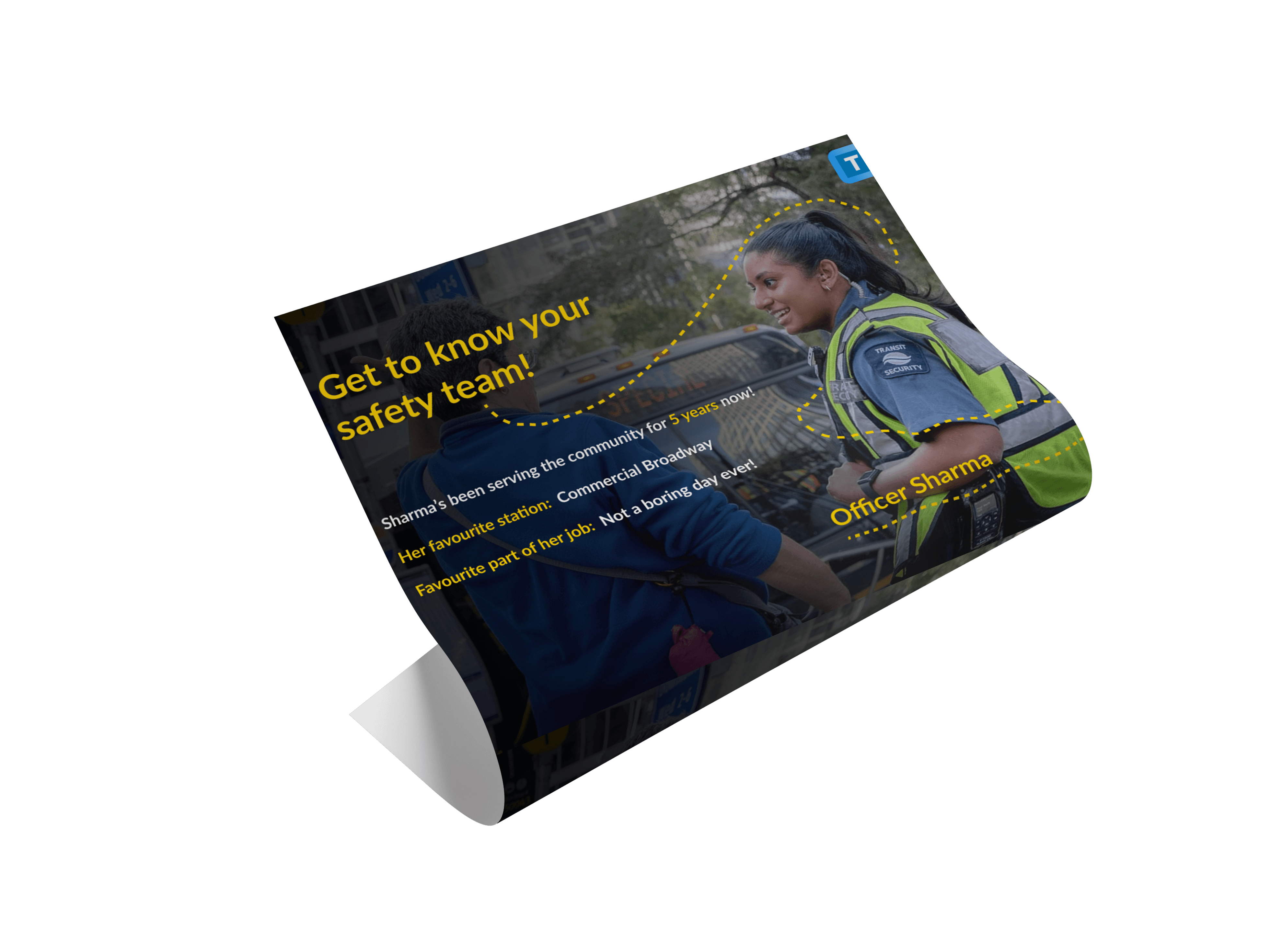
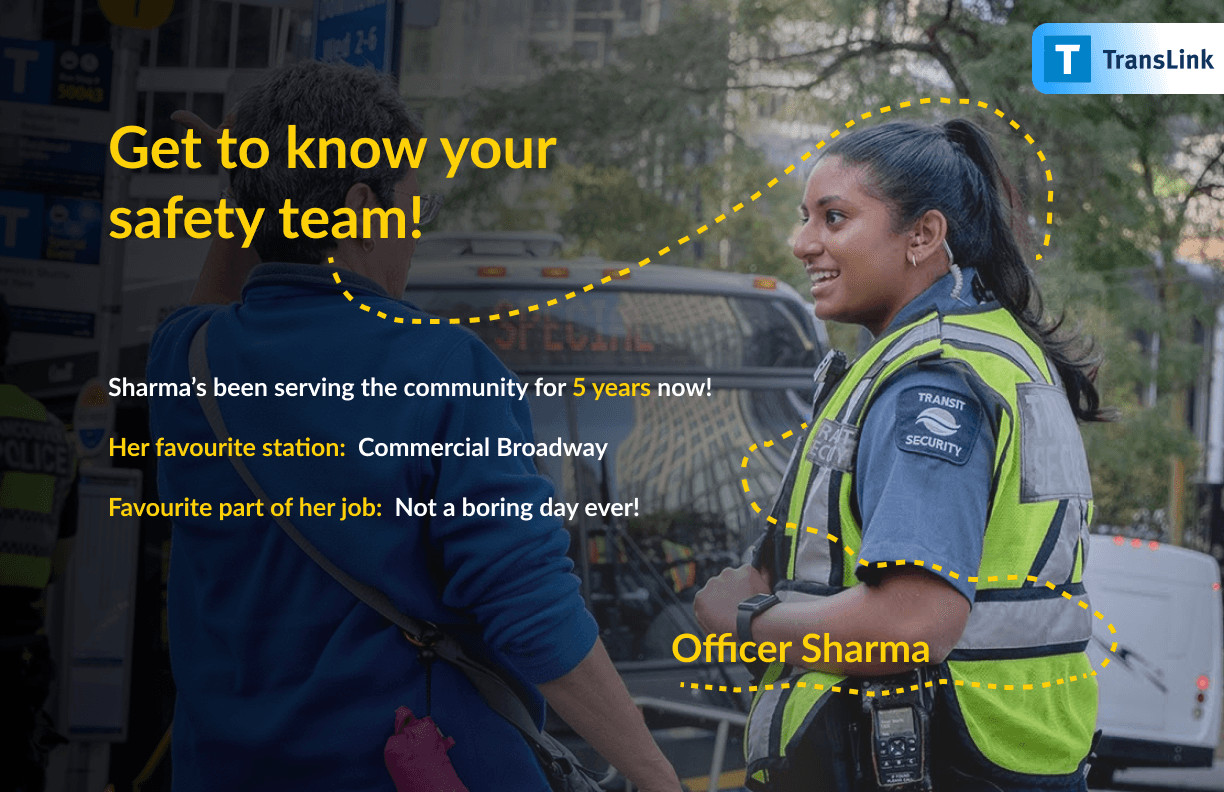
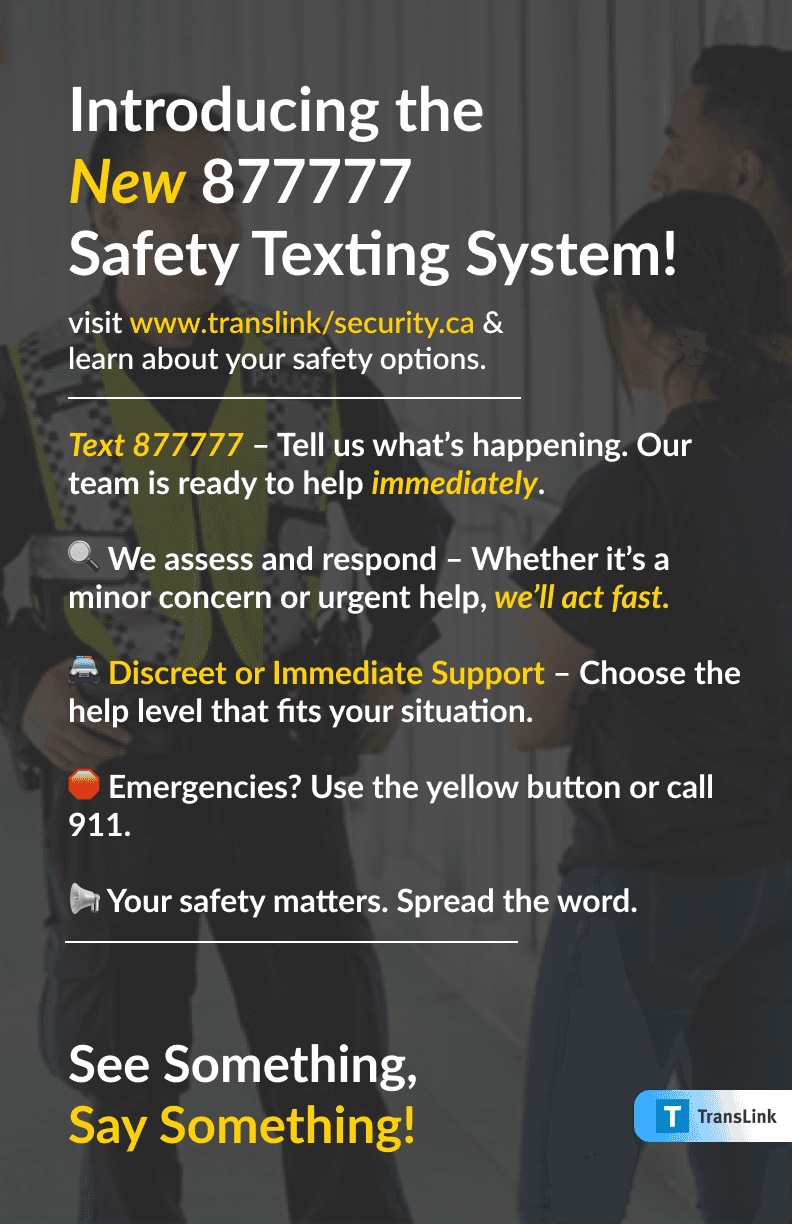
I designed some posters for trust campaign first the aim was to send a message that authorities were there to help people. I also thought of maybe using these as a medium for people to get know the staff and develop a sense of familiarity through this poster below.
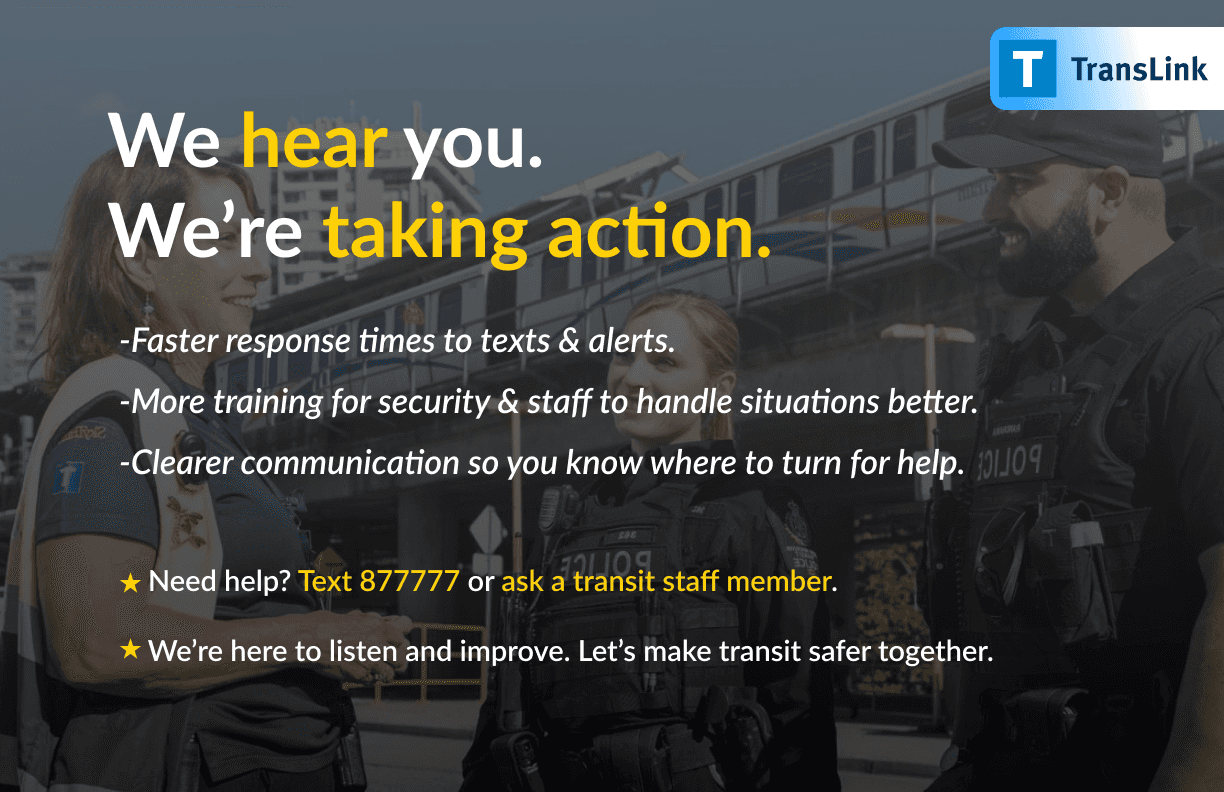
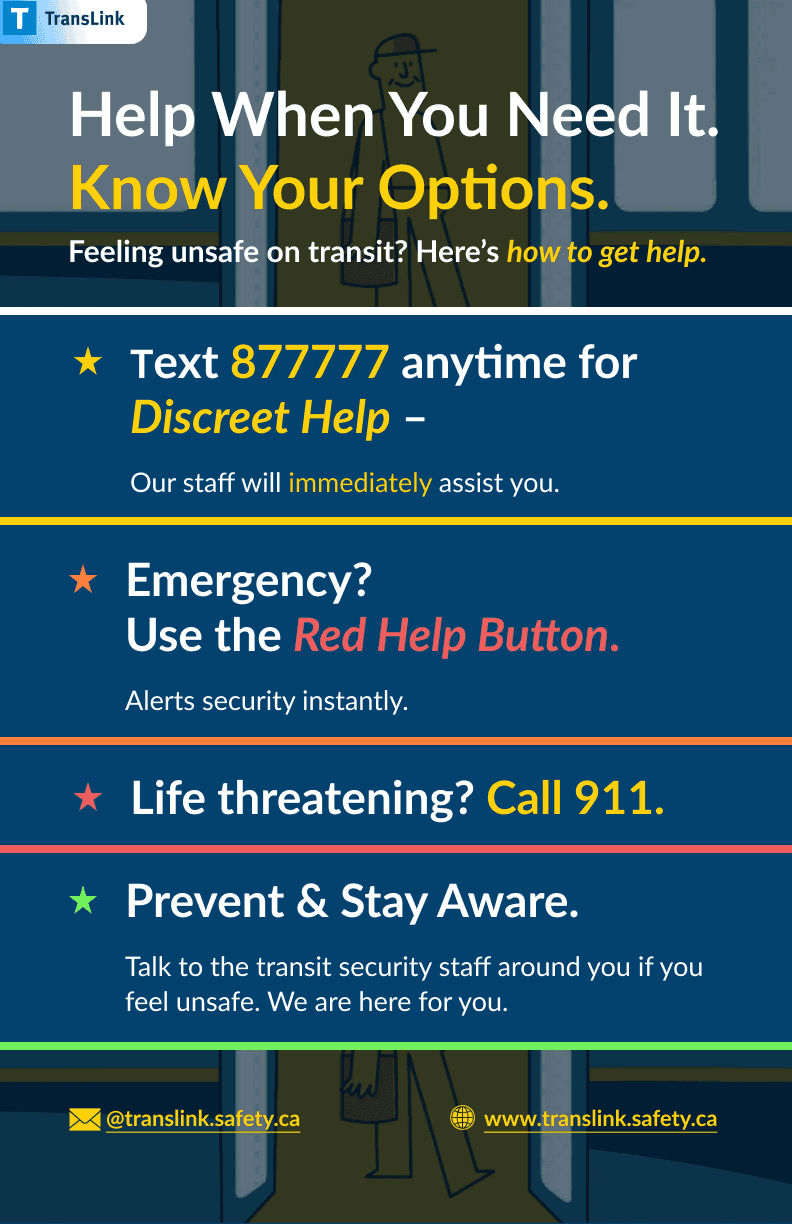
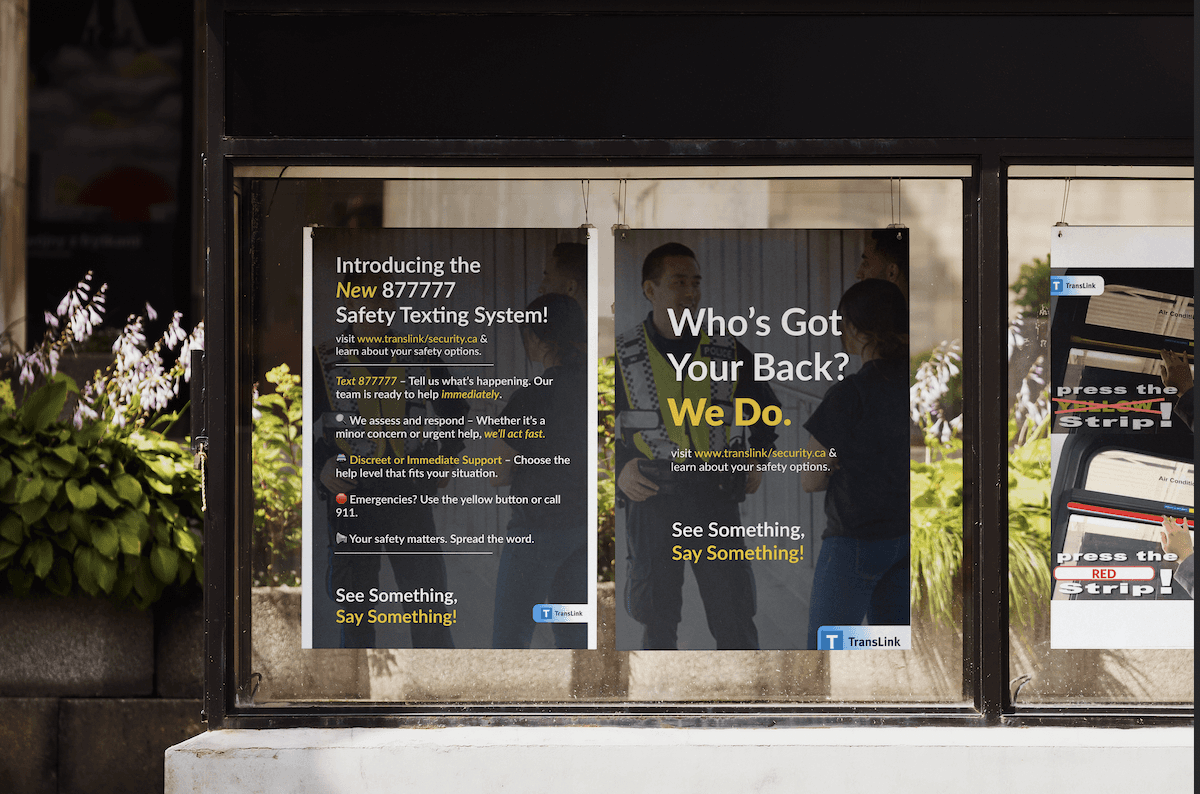
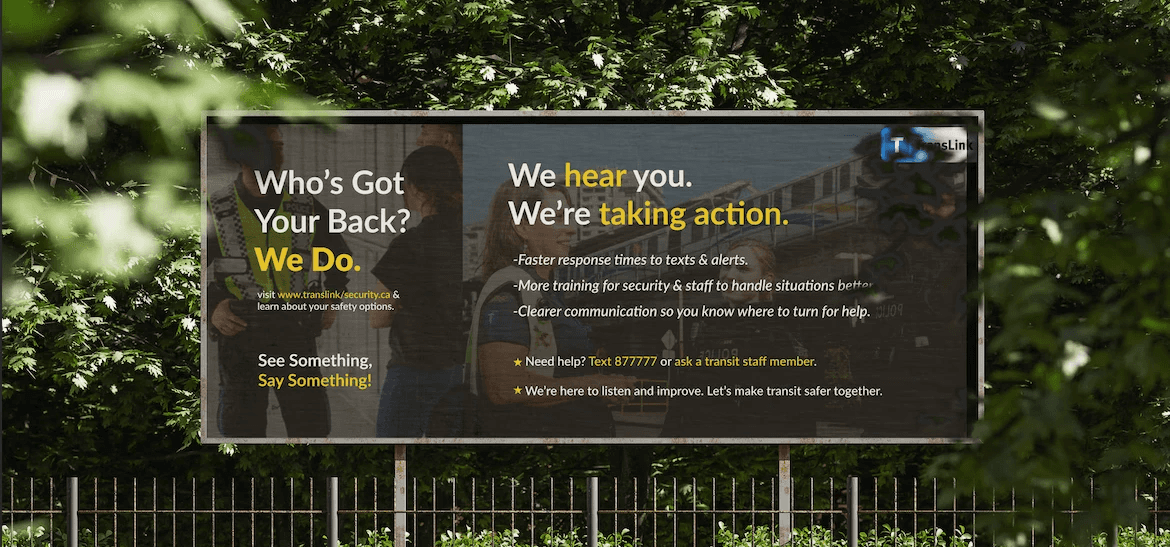
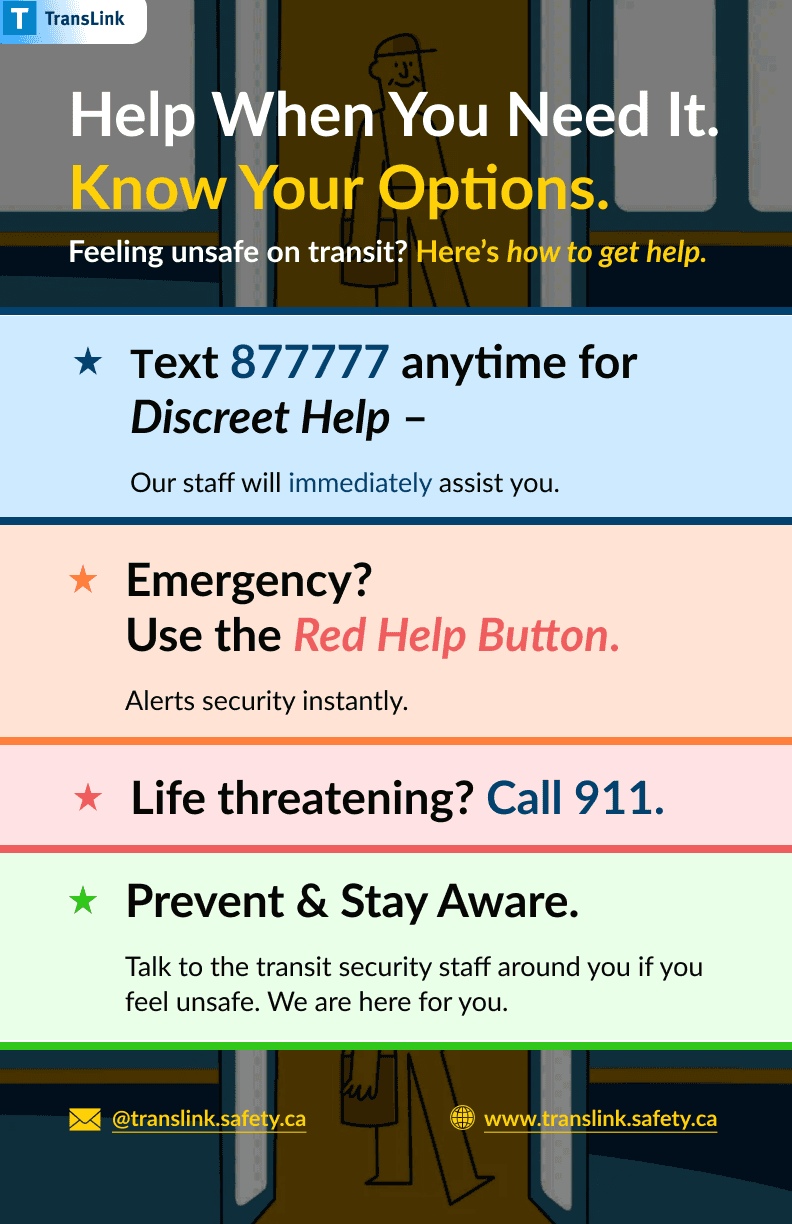
I also designed some posters for the awareness campaign. The main focus was to ensure legibility and accessibility for commuters with different needs.
Reflection

After a research session in class, I realized that simply 'humanizing' authorities through a campaign wouldn’t be the best way to build trust; especially for marginalized groups who have faced years of systemic oppression from these very institutions.


If I had more time with this project, I would pivot toward a

Community Co-Design Approach.

Systemic issues like these can’t be solved through design alone; they require more power than designers hold. Organizing a co-design and co-creation workshop with marginalized groups would be a meaningful shift, allowing those with firsthand experience to shape solutions they can actually trust.
Another direction worth exploring is active bystander training. Encouraging community members to help each other could foster a greater sense of responsibility and make public transit feel safer through collective action.

This project took me in directions I didn’t expect. At first, I thought the biggest challenge was making TransLink’s safety response faster and more accessible. But as I dug deeper, I realized a much bigger issue, how emergencies are defined. I hadn’t really questioned it until I found myself in a situation where I wasn’t sure if what I was experiencing was “urgent enough” to ask for help. That moment made me rethink everything.


I also didn’t consider universal barriers or excluded groups at first, but once I identified them, they completely reshaped my approach. Not everyone has a phone, trusts transit security, or finds texting an easy way to communicate. These gaps highlighted how different people experience the system, which pushed me to design with those realities in mind.


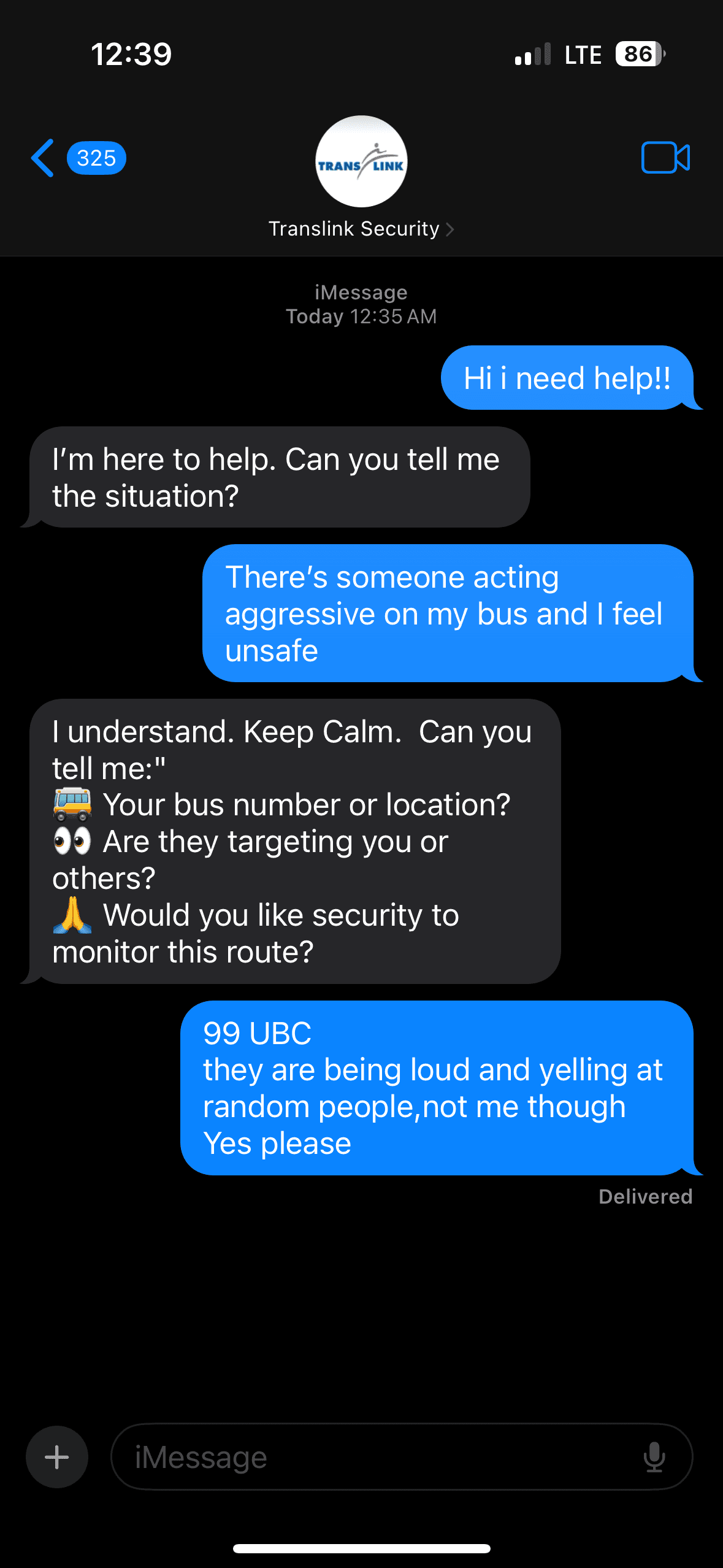
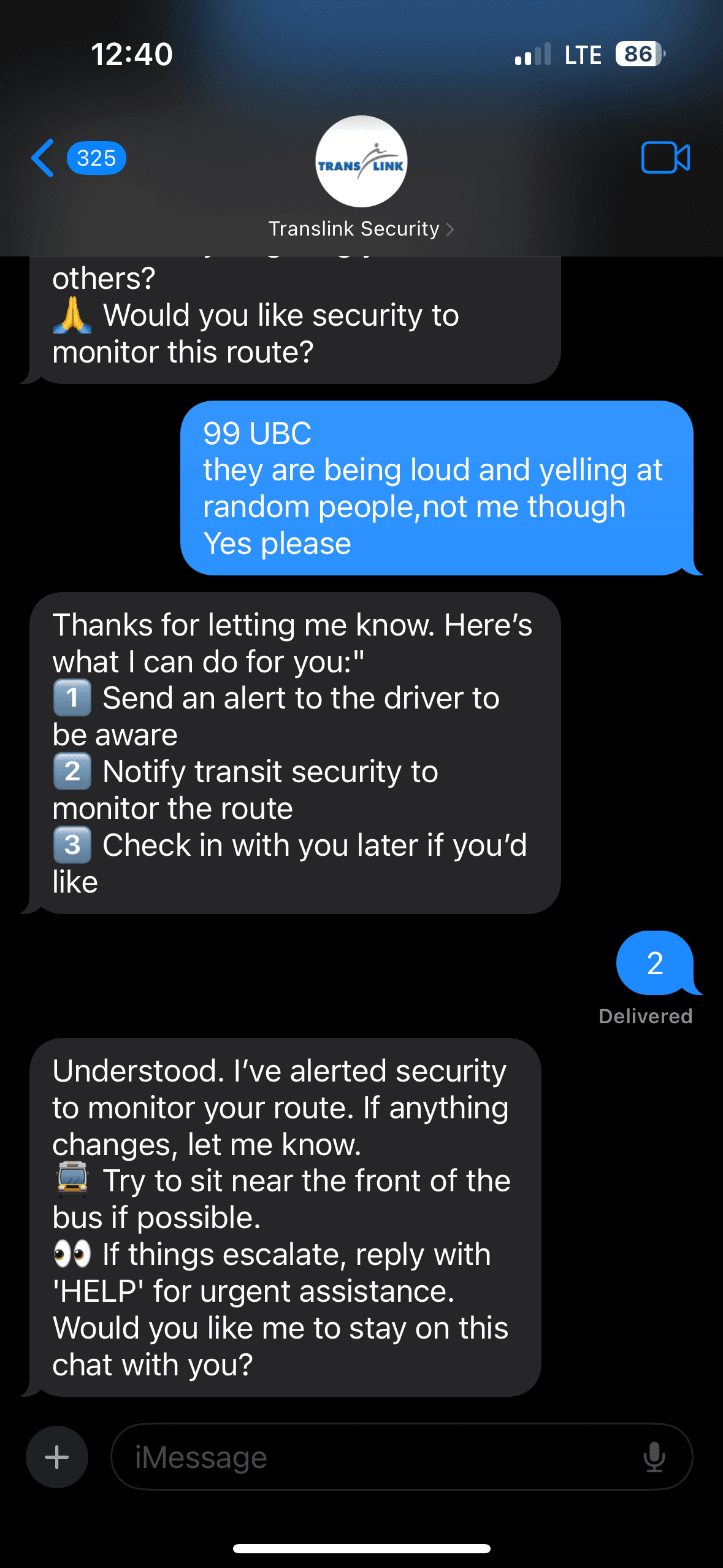
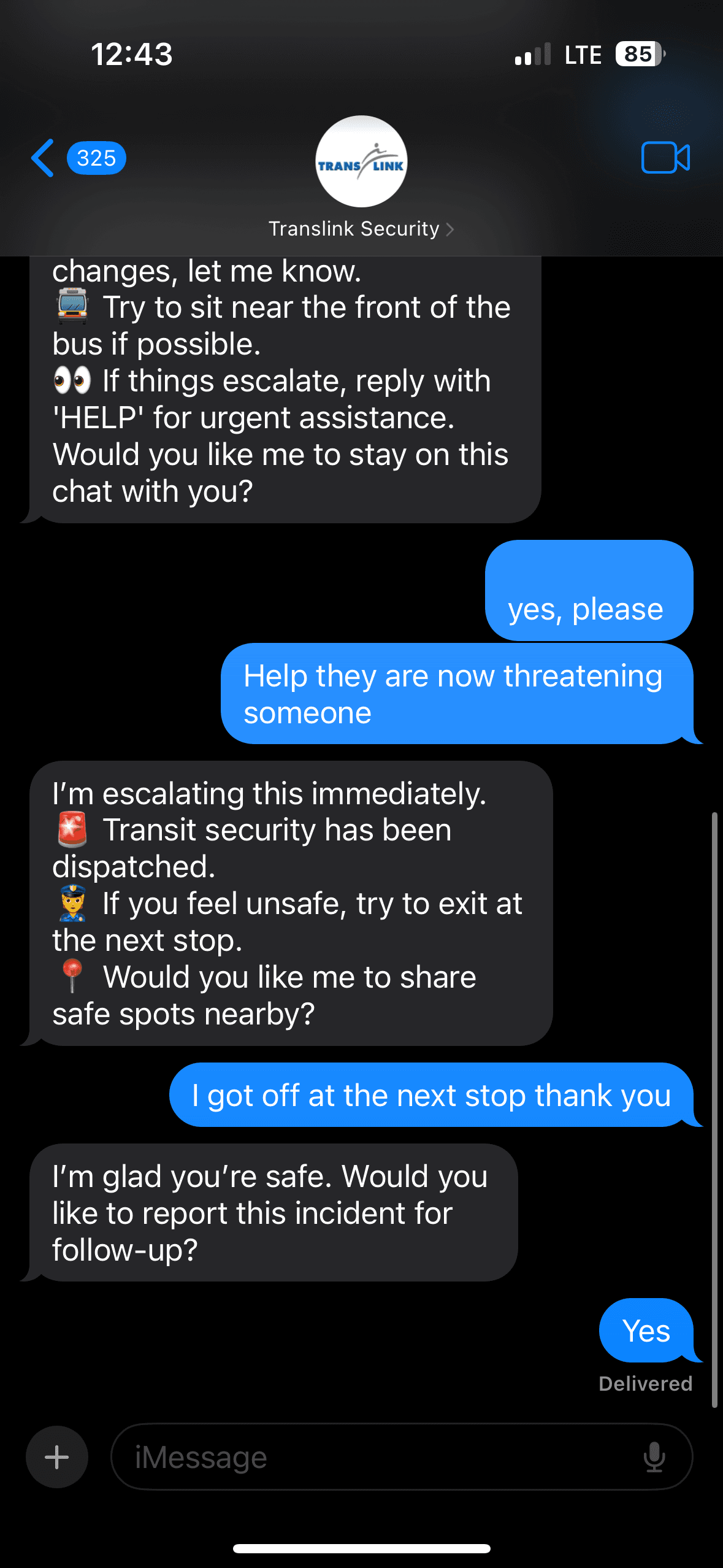
Originally, I planned for a fully human-operated texting service, but after research and testing, I realized a chatbot-assisted system would be faster, more scalable, and still allow human intervention when necessary. Prototyping conversations helped me see how small details like tone, response time, and wording—could impact how safe someone feels when reaching out for help.


If I had more time, I’d pivot the project toward a community-led co-design approach, ensuring that marginalized groups shape solutions they actually trust. I’d also explore active bystander training to empower transit users to support each other rather than relying solely on authorities.


This project showed me that improving safety isn’t just about efficiency, it’s about trust, accessibility, and making sure the system works for those who need it most.

What's next?

This project took me in directions I didn’t expect. At first, I thought the biggest challenge was making TransLink’s safety response faster and more accessible. But as I dug deeper, I realized a much bigger issue, how emergencies are defined. I hadn’t really questioned it until I found myself in a situation where I wasn’t sure if what I was experiencing was “urgent enough” to ask for help. That moment made me rethink everything.


I also didn’t consider universal barriers or excluded groups at first, but once I identified them, they completely reshaped my approach. Not everyone has a phone, trusts transit security, or finds texting an easy way to communicate. These gaps highlighted how different people experience the system, which pushed me to design with those realities in mind.


Originally, I planned for a fully human-operated texting service, but after research and testing, I realized a chatbot-assisted system would be faster, more scalable, and still allow human intervention when necessary. Prototyping conversations helped me see how small details like tone, response time, and wording—could impact how safe someone feels when reaching out for help.


If I had more time, I’d pivot the project toward a community-led co-design approach, ensuring that marginalized groups shape solutions they actually trust. I’d also explore active bystander training to empower transit users to support each other rather than relying solely on authorities.


This project showed me that improving safety isn’t just about efficiency, it’s about trust, accessibility, and making sure the system works for those who need it most.

Create a free website with Framer, the website builder loved by startups, designers and agencies.